





For a long time, individual investors couldn’t get there. The minimum commitments were too high, the operational demands too significant, and the access points too limited.
That’s changed. Private real estate funds now give accredited investors a direct path into professionally managed real property, without the responsibilities of direct ownership.
This article explains how private real estate funds actually work, why institutional allocators have historically favored the asset class, and what to look for when evaluating whether a private real estate fund belongs in your portfolio.
How Private Real Estate Funds Actually Work
A private real estate fund pools capital from multiple investors to acquire and manage a portfolio of properties. Rather than buying a building yourself, you contribute to a fund that does the buying and managing. The fund manager handles everything: sourcing deals, conducting due diligence, arranging financing, overseeing property operations, and distributing income back to investors.
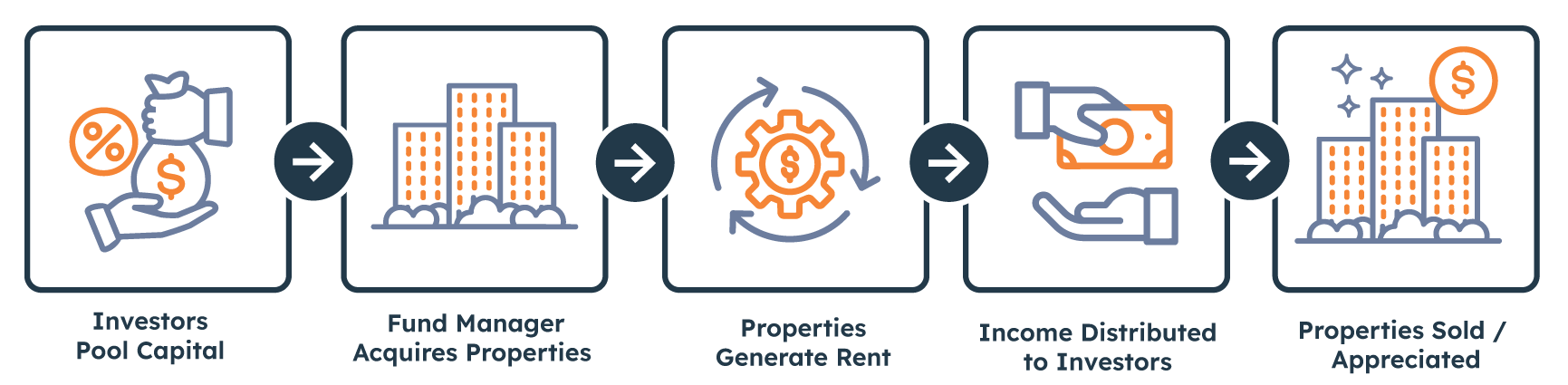
Most private real estate funds fall into one of two structural categories: closed-end funds and open-end (or evergreen) funds.
Closed-end funds operate on a fixed timeline, typically seven to 10 years. Capital is raised during a defined window, deployed into properties, and eventually returned to investors through rental income and asset sales. Investors know roughly when they’ll get their capital back, but they have limited flexibility to access it early.
Evergreen funds don’t have a fixed end date. They accept new capital on an ongoing basis and provide investors with periodic redemption opportunities rather than a single liquidation event at the fund’s close. This structure allows for a longer investment horizon and more consistent capital deployment, but it also means liquidity is managed carefully, with redemption windows typically offered quarterly with defined limits on how much can be returned in any given period.
Understanding the structure of a fund before you invest isn’t just a procedural step. It tells you how the manager thinks about time horizon, liquidity management, and the relationship between their interests and yours.
Why Institutional Investors Have Historically Favored It
Institutional investors don’t favor private real estate because it’s a trendy or opportunistic choice. They favor it because it has specific characteristics that address real portfolio challenges.

Low correlation to public markets. Private real estate values are driven primarily by property income, local supply and demand dynamics, and physical asset quality, rather than daily equity market sentiment. Real estate fundamentals, specifically occupancy rates, local rental demand, and property-level cash flow, move on their own cycle, distinct from the sentiment-driven swings that affect publicly traded securities. The portfolio diversification benefit is structural, not incidental.
Income generation. Real property generates rental income, and a significant portion of private real estate fund returns has historically come from that income stream rather than from appreciation alone. For investors managing a portfolio that needs to generate cash, without constantly selling positions, income from real assets can serve a distinct function.
Inflation sensitivity. Rents tend to rise over time, particularly in markets where housing demand outpaces supply. That dynamic gives real estate a degree of inflation sensitivity that bonds, for example, don’t offer. It’s not a guarantee, but it’s a structural characteristic that has made the asset class attractive in inflationary environments.
Tangible asset backing. Real property has inherent value independent of market sentiment. A well-located apartment building in a growing market has utility (people need housing) that doesn’t disappear when investor psychology shifts.
None of these characteristics eliminate risk. Real estate can and does decline in value. Markets can soften. Occupancy rates can drop. Financing costs can compress returns. Institutional investors understand this, which is precisely why they conduct rigorous due diligence before committing capital and why fund governance matters as much as the investment thesis.
The Real Return Profile: Income, Appreciation, and How Value Is Built
Private real estate funds typically generate returns through two sources: current income from rents and long-term appreciation as property values increase.
Current income is distributed to investors periodically, with most funds paying quarterly. The yield on a given investment depends on the quality and location of the properties, the purchase price relative to the income they generate, the fund’s use of leverage, and the operating efficiency of the manager.
Appreciation comes from multiple directions. Property values can increase as rents grow over time, as the physical asset is improved through capital investment, or as the surrounding market becomes more attractive to tenants and future buyers. In a value-add strategy, the manager acquires properties that are underperforming relative to their potential, makes targeted improvements, and repositions them to achieve higher rents and, ultimately, higher sale prices.
The combination of income and appreciation is what generates total returns. But the split between those two sources varies meaningfully by fund strategy. A core fund focused on stabilized, income-producing properties will generally deliver more consistent income with lower appreciation potential. A value-add or opportunistic fund will typically sacrifice near-term income in favor of larger appreciation upside, though with more risk in the process.
Knowing which return profile aligns with your own investment goals, tax situation, and time horizon is one of the most important questions to answer before selecting a fund.
The Appeal of Multifamily Real Estate in Private Investment Funds
Among the various property types in private real estate, including office, retail, industrial, and residential, multifamily has attracted significant institutional attention, and for reasons that hold up to scrutiny.
According to CBRE, multifamily accounted for the largest share of total U.S. commercial real estate investment volume in Q1 2025, representing approximately 33% of transaction activity, and has consistently ranked as the most preferred asset class among commercial real estate investors. (CBRE, U.S. Multifamily Market Report, Q1 2025)Multifamily properties, meaning apartment buildings and rental communities, benefit from one of the most consistent demand drivers in any market: people need a place to live. That basic fact doesn’t eliminate risk, but it does provide a demand floor that other property types don’t have in the same way. Retail demand is shaped by shifting consumer behavior. Office demand is tied to corporate real estate decisions. Residential demand is tied to population and household formation, forces that move slowly and predictably.
In the United States, the Sunbelt markets, in particular, have attracted attention from institutional multifamily investors. Florida, Texas, North Carolina, and Arizona have seen sustained population growth driven by migration patterns, job creation, and relative affordability compared to coastal gateway cities.
According to U.S. Census Bureau Vintage 2023 estimates, Texas added more residents than any other state between 2020 and 2023, growing by approximately 1.2 million people, while Florida and South Carolina ranked among the top states for percentage growth rate. That population growth creates housing demand, and in markets where supply hasn’t fully caught up, rents have risen accordingly. (U.S. Census Bureau, Vintage 2023 Population Estimates, December 2023)
The current moment deserves a realistic assessment, though. Several Sunbelt markets experienced significant new supply deliveries in 2022 and 2023, which temporarily softened vacancy rates and rent growth. That supply is being absorbed. Experienced multifamily operators who understand local dynamics, specifically where supply and demand are coming back into balance, are positioning for what may be a favorable entry point in the cycle. Entry point matters. The same asset purchased at a disciplined price in a recovering market often performs materially better than the same asset bought at peak valuations.
What to Look for in a Private Real Estate Fund Before You Invest
The private real estate fund market has grown significantly, and not all operators are equivalent. Before committing capital, there are a handful of questions worth pressing on.
Investment process documentation. A credible manager can explain specifically how they evaluate a property before acquiring it: what they look at, what disqualifies a deal, and what an investment must demonstrate before capital is committed. The ratio of properties reviewed to properties acquired is one useful signal. If a manager can’t articulate a documented process, that’s worth noting.
Governance structure. Who provides oversight, and how? A majority-independent board, meaning external professionals with no management relationship to the fund, adds a layer of investor protection that a self-governed structure doesn’t. It’s not legally required in many fund structures. Managers who build it in anyway are signaling something about how seriously they take their obligations to investors.
Audit standard. Who audits the fund and to what standard? A recognized, independent auditing firm (such as one of the major global accounting firms) provides external validation of the financials that investors rely on. Ask for this information directly.
Liquidity terms. Evergreen funds offer periodic redemption, but the specific terms matter. What is the redemption window? What limits apply in any given period? Under what circumstances might redemptions be suspended or limited? These aren’t scary questions. They’re appropriate ones. A fund with well-designed liquidity terms will answer them straightforwardly.
Fee structure. Management fees, performance fees, acquisition fees, and fund-level expenses can collectively have a significant impact on net returns. Ask for the complete fee picture, not just the management fee, and ask a manager to walk you through the economics at target performance and at below-target performance.
Making Private Real Estate Part of Your Portfolio
Private real estate isn’t right for every investor, and no reputable manager will suggest otherwise. It requires a long-term horizon, comfort with a degree of illiquidity compared to public markets, and tolerance for the inherent risks in real property, including market cycles, vacancy, and the operational realities of owning physical assets.
But for investors who meet those criteria, the asset class offers what most portfolios are missing: real property income, the potential for appreciation over full market cycles, and a return profile that doesn’t depend entirely on equity market performance.
The institutional investors who have held private real estate through multiple cycles have done so for those reasons. They aren’t a different kind of investor. They simply had access to the asset class.
If you’re exploring whether private real estate belongs in your portfolio, the right first step is simply to learn more. There’s no obligation to invest, and there’s a lot to understand before you should.
Take the Next Step
- Sign up for expert insights on passive income strategies
- Follow us on social media to stay up to date with the latest news and trends