




Do I Qualify as an Accredited Investor?
Table of contents
- What Is an Accredited Investor in the United States?
- What Are the Net Worth Requirements for an Accredited Investor?
- Understanding Private Real Estate as an Investment Category
- Benefits of Being an Accredited Investor: Investment Opportunities Beyond Public Markets
- Private Real Estate Investing for Accredited Investors: What to Look for in a Fund
- Why Multifamily in Private Real Estate Funds? Income and Appreciation Potential
- Questions to Ask Before You Invest in Any Private Real Estate Fund
- Is This the Right Time to Look at Private Real Estate?
- Frequently Asked Questions
Nearly 1 in 5 U.S. households now qualifies as an accredited investor - up from just 1.8% in 19831.
More than 24 million households with access to private investment opportunities most people never see. If you've been building wealth through public markets and wondering what else is available, this is where that conversation starts.
Private real estate funds, private equity offerings, and other alternative investments are generally restricted to accredited investors only. Before you can review most fund documents, let alone invest, you need to meet the threshold.
So what is an accredited investor, exactly? Do you qualify? And if you do, what does it actually open up for your portfolio? This article answers all three questions directly.
What Is an Accredited Investor in the United States?
The accredited investor designation is defined by the U.S. Securities and Exchange Commission under Regulation D of the Securities Act of 1933. It identifies individuals who are eligible to participate in private securities offerings, investments that are not registered with the SEC and therefore don’t carry the same public disclosure requirements as stocks, bonds, or publicly traded funds.
The designation exists because private investments carry risks and structural complexity that publicly registered investments don’t. They’re less liquid, less transparent on a daily basis, and require a longer-term commitment. The accredited investor threshold reflects the regulatory intent that participants have sufficient financial resources to absorb potential losses, alongside the experience and context to evaluate what they’re getting into.
It’s worth being direct about what the status is not. It isn’t a certification of investment knowledge, and it doesn’t mean a private investment is right for you simply because you qualify. It means you’re eligible to evaluate opportunities that most people aren’t.
What Are the Net Worth Requirements for an Accredited Investor?
Under current SEC rules, you qualify as an accredited investor as an individual if you meet any one of the following criteria.
Net Worth Test Your net worth exceeds $1 million, either individually or jointly with a spouse or spousal equivalent. One important detail: your primary residence does not count toward this figure. The $1 million threshold reflects investable or liquid wealth, not the equity built up in your home.
Income Test Your individual income exceeded $200,000 in each of the two most recent calendar years, with a reasonable expectation of reaching the same level in the current year. If you file jointly with a spouse or spousal equivalent, the combined income threshold is $300,000.
Professional Credentials Test The SEC expanded the definition in 2020 to recognize financial experience beyond net worth alone. Individuals who hold certain professional certifications, including a FINRA Series 7, Series 65, or Series 82 license in good standing, now qualify regardless of their net worth or income.
Most individual investors who reach the accredited threshold do so through the net worth or income tests. If you’re a business owner, senior executive, physician, attorney, or other high-income professional, there’s a reasonable chance you already qualify. The question is whether you’ve confirmed it and whether you’ve thought about what to do with that access.
One practical note: when you invest in a 506(c) offering, the fund manager is required to take reasonable steps to verify your accredited investor status. That typically means providing documentation such as tax returns, brokerage statements, a letter from a CPA or attorney, or a third-party verification service. The process is standard and not particularly burdensome, but it’s worth knowing it’s required before you begin an application.

Understanding Private Real Estate as an Investment Category
Once you’ve confirmed you qualify, the next question is a practical one: what types of investment opportunities does accredited investor status actually open up?
Private real estate is one of the most common areas accredited investors explore. It operates differently from the real estate exposure available through public markets, and understanding those differences is important before committing capital to anything.
Publicly traded Real Estate Investment Trusts, or REITs, are listed on stock exchanges. Their prices can move based on broad market sentiment, in addition to the performance of the underlying properties. That daily liquidity is a meaningful convenience, and REITs have a well-established role in many portfolios. But their pricing dynamics are tied to public market conditions in ways that private real estate is not.
Private real estate funds are not publicly traded. Valuations are tied to real property fundamentals: what the buildings generate in rent, what they’d sell for in the current market, and how well they’re being operated. That difference in valuation methodology is part of what has historically contributed to private real estate’s lower correlation to public equity markets, though no allocation eliminates risk.
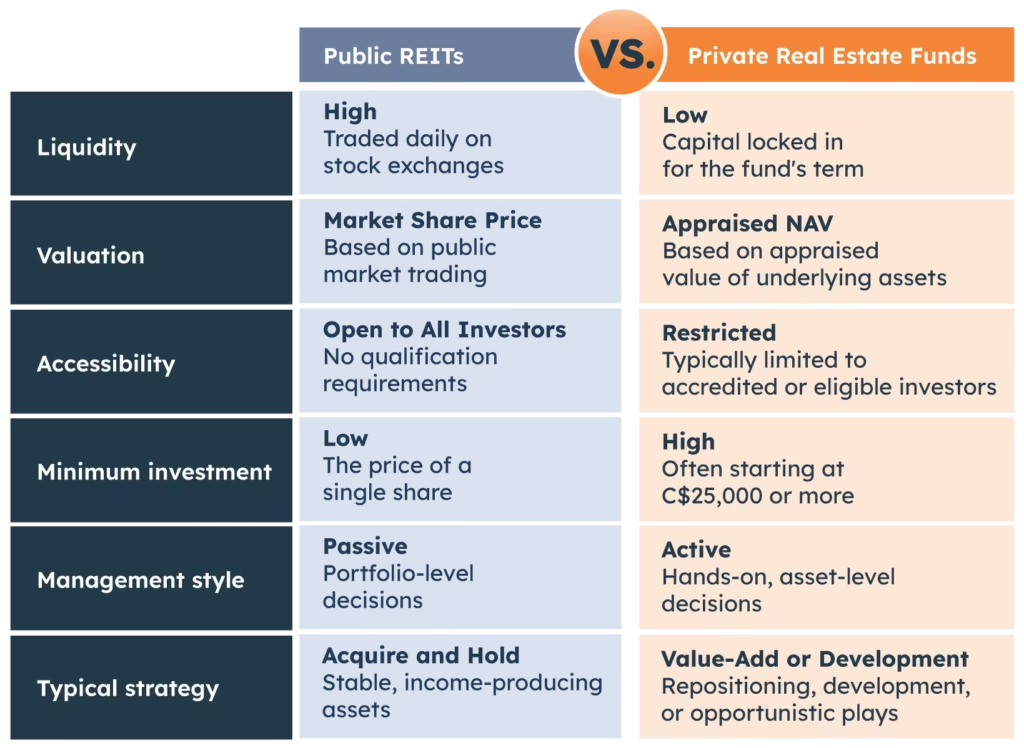
Private real estate funds are typically structured as private placements under Regulation D of the Securities Act of 1933 (17 C.F.R. § 230.506), which provides an exemption from SEC registration for qualifying offerings. This structure allows funds to be more focused in their strategy, more selective about the properties they acquire, and more tailored in how they’re governed than their publicly registered counterparts.
The tradeoff is liquidity. You cannot sell your position in a private fund the way you’d sell a publicly traded security. It’s not inaccessible, but it requires a longer-term commitment and a clear-eyed understanding of those terms before you invest.
Benefits of Being an Accredited Investor: Investment Opportunities Beyond Public Markets
The accredited investor designation is sometimes discussed as if the status itself is the benefit. It isn’t. The benefit is what the status enables.
For investors who have spent years building wealth primarily in public markets, accredited investor status opens access to an asset class that institutional investors have allocated to for decades: private real estate.
Pension funds, university endowments, and family offices have held private real estate alongside public equities and fixed income not as a speculation but as a deliberate allocation decision. They do it because the return profile addresses specific portfolio problems.
Income from real property Private real estate funds generate income through rent collected from the properties they own. That income is distributed to investors periodically, on a regular basis. For investors who want their portfolio to generate cash without constantly selling positions, income from real assets serves a distinct function.
Potential for appreciation over time Real property values can increase as rents grow, as physical improvements raise a property’s quality, and as the surrounding market strengthens. That appreciation potential is a second source of return alongside the income stream.
Lower correlation to public markets Because private real estate values are driven by property fundamentals rather than daily trading, the asset class has historically moved differently from public equities. That doesn’t mean it’s without risk, but it does mean that a private real estate allocation may behave differently in your portfolio during periods of public market volatility.
Tangible asset backing A multifamily building in a growing market has inherent utility that doesn’t disappear when investor sentiment shifts. People need a place to live. That demand driver is more stable than what supports most financial assets.
None of these characteristics eliminate risk. Real estate markets cycle. Vacancies rise. Financing costs can compress returns. Understanding and evaluating these risks is essential to making informed investment decisions.
Private Real Estate Investing for Accredited Investors: What to Look for in a Fund
Not all private real estate funds are equivalent, and the growth of the category in recent years means there are more options, more marketing claims, and more variation in quality than there was a decade ago.
The accredited investor designation tells you that you’re eligible. It doesn’t tell you which funds are worth your time.
For investors evaluating any private real estate fund, a few things are worth pressing on before you go further. Governance structure matters: is there independent oversight built into the fund, or just promised in the marketing? Ask who audits the fund and to what standard. Ask for the complete fee picture, not just the management fee. And ask what the redemption terms are, specifically what limits apply in any given quarter and under what circumstances redemptions might be limited.
A fund that can answer these questions directly is telling you something. One that deflects them is telling you something too.
Why Multifamily in Private Real Estate Funds? Income and Appreciation Potential
Among the property types that private real estate funds hold, multifamily has attracted sustained institutional attention. The reason holds up to scrutiny.
Multifamily properties, meaning apartment buildings and residential rental communities, benefit from one of the most consistent demand drivers in any market: people need housing. That doesn’t eliminate the risks associated with any real estate investment, but it does provide a demand floor that most other property types can’t match. Office demand is tied to corporate real estate decisions that have been shifting for years. Retail demand depends on consumer behavior patterns. Residential demand is tied to population growth and household formation, forces that move slowly and predictably.
The Sunbelt markets, in particular, have attracted serious attention from institutional multifamily investors. Florida, Texas, North Carolina, and Arizona have seen sustained population growth driven by migration, job creation, and relative affordability compared to gateway cities. That population growth creates housing demand, and in markets where supply hasn’t fully caught up, that dynamic has historically supported rent growth.
A realistic assessment of where the market stands right now: several Sunbelt markets saw significant new supply delivered in 2022 and 2023, which temporarily softened vacancy rates. That supply cycle is progressing. According to data from CoStar Group, multifamily construction starts in key Sunbelt metros declined materially in 2024, with new deliveries expected to taper through 2025 and 2026 as financing conditions tightened.2 Meanwhile, population growth in Florida and Texas continued to outpace the national average, with the U.S. Census Bureau reporting net domestic migration to these states among the highest in the country in 2023 and 2024.3 Investors who understand local market dynamics, specifically where supply and demand are coming back into balance, see what a compelling entry point may be. Entry timing matters. The same asset acquired at a disciplined price in a recovering market may perform meaningfully better than the same asset bought at peak valuations.
Questions to Ask Before You Invest in Any Private Real Estate Fund
The accredited investor threshold is a starting point, not a finish line. Before committing capital to any private fund, there are questions worth asking directly.
What is the investment process? A credible fund manager can explain specifically how they evaluate a property: what criteria a deal must meet, what disqualifies it, and what the ratio of deals reviewed to deals acquired looks like. If a fund manager can’t walk through this clearly, that’s useful information.
What does the governance structure look like? Independent board oversight, meaning external professionals with no management relationship to the fund, adds a layer of investor protection that a self-governed structure doesn’t offer. It’s not legally required in most fund structures. Managers who build it in are signaling something about their obligations to investors.
Who audits the fund, and to what standard? An independent, recognized auditing firm provides external validation of the financials you’ll rely on. Ask directly.
What are the full fees? Management fees, performance fees, acquisition fees, and fund-level expenses together determine your net return. Ask for the complete picture at target performance and at below-target performance.
What do the liquidity terms actually say? Evergreen funds offer periodic redemption, but the specific terms matter. What is the redemption window? What limits apply per quarter? Under what circumstances might redemptions be suspended? These are reasonable questions that any reputable fund should answer without hesitation.
Is the fund right for your situation? Private real estate is designed for investors with a long-term horizon who are comfortable with limited liquidity compared to publicly traded investments. Redemption windows exist, but they are periodic and subject to defined limits. Investors who may need regular or near-term access to their capital should carefully review the specific liquidity terms of any fund before committing.
Is This the Right Time to Look at Private Real Estate?
The honest answer is that timing is less important than matching the investment to your actual situation. What matters more than market timing is your own time horizon, your liquidity needs, and whether the asset class makes sense as part of your broader portfolio.
That said, the current environment in Sunbelt multifamily does represent what experienced operators view as a potentially favorable entry point. The oversupply that softened some markets after the pandemic is being absorbed: According to CoStar Group, the national multifamily vacancy rate peaked at 7.9% in Q3 2024, the first quarterly decline in three years, as demand began to outpace new supply. At the same time, the construction pipeline has thinned sharply: multifamily completions are projected to drop to roughly 495,000 units in 2025, down 30% from the record 700,000 units delivered in 2024. Meanwhile, population growth in Florida and Texas continued to outpace the national average, with the U.S. Census Bureau reporting Texas and Florida among the top states for population growth in 2024. Investors who understand local market dynamics, specifically where supply and demand are coming back into balance, see what may be a compelling entry point. Entry timing matters. The same asset acquired at a disciplined price in a recovering market may perform meaningfully better than the same asset bought at peak valuations.
As per the CoStar Group, multifamily vacancy rates across major Sunbelt metros peaked in mid-2024 and have been trending downward as new supply deliveries taper. With construction starts down sharply from their 2022 peak, the pipeline of new units entering these markets through 2026 is expected to be significantly smaller than what was delivered over the prior two years.2

The U.S. Census Bureau reported Texas (133,372), Florida (126,008), and North Carolina (106,592) as the top three states for net domestic in-migration in 2023, with all three continuing to record above-average population growth into 2024.3 For investors with a long-term horizon, the convergence of a shrinking supply pipeline and sustained population growth is the kind of setup experienced operators watch for. Those who study these markets closely are paying attention.
If you qualify as an accredited investor, the question isn’t whether to consider private real estate. The question is whether you have the right information to evaluate it. That starts with understanding exactly what you’re looking at, who is behind it, and whether their process holds up to scrutiny.
Take the Next Step
- Sign up for expert insights on passive income strategies
- Follow us on social media to stay up to date with the latest news and trends
2 CoStar Group, U.S. Multifamily Market Analytics, 2024.
3 U.S. Census Bureau, Population Estimates, Vintage 2023–2024.
Frequently Asked Questions
No. The SEC’s net worth test for accredited investor status specifically excludes the value of your primary residence. The $1 million threshold reflects net worth outside your home, including liquid assets, investment accounts, and other real or personal property. If your home equity represents the majority of your net worth, you may not meet the threshold even if your total net worth appears to exceed $1 million on paper.
Both designations determine eligibility for certain private investments, but the thresholds are different. An accredited investor must meet the $1 million net worth test (excluding primary residence) or the income test ($200,000 individual / $300,000 joint). A qualified purchaser has a higher threshold, generally $5 million in investments. Some private funds are limited to qualified purchasers only, while others, like 506(c) Regulation D offerings, are available to all accredited investors.
Yes. Private real estate funds carry several considerations that publicly traded structures don’t. Liquidity is the most significant: positions in private funds are not tradeable on any exchange, and redemption options are typically limited to defined quarterly windows with caps on the amount that can be redeemed in any given period. Private funds are also not required to publish daily net asset values, so valuations are updated less frequently than publicly traded securities. And private placements have less regulatory disclosure requirements than registered offerings, which places more responsibility on the investor to conduct thorough due diligence before committing capital.
Minimums vary significantly by fund. Some direct-to-investor platforms accept commitments starting at $10,000 to $25,000. Institutional-quality funds targeting accredited investors often set minimums at $50,000 to $100,000 or higher, reflecting the investor profile and the cost structure of the fund. Higher minimums aren’t necessarily a sign of quality, but they do signal something about the target investor audience. Always ask whether the minimum investment makes sense as a proportion of your total investable assets before committing.