




How to Build Passive Income with Real Estate: A Complete Guide
37%
If you know real estate builds wealth but don’t own any outside of your primary residence, it’s likely not for lack of interest, it’s the time and effort that can be overwhelming. Managing tenants, repairs, and day-to-day operations can quickly consume hours that high-net-worth individuals could spend on business, family, or other investments. Today, professionally managed private funds and private Real Estate Investment Trusts (REITs) provide access to institutional-grade real estate without the headaches of landlord duties, letting you grow your portfolio on your terms.
This guide breaks down some of the investment options available to you, from rental properties to private equity real estate funds, so you can move from intention to action.
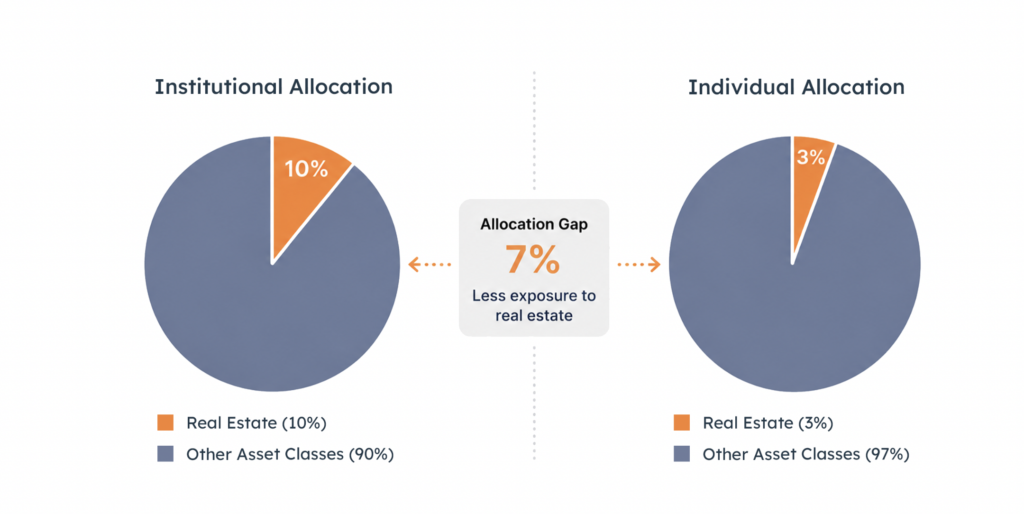
Today, private real estate funds allow individual investors to access similar opportunities, offering:
- Investing alongside others to own large, professionally managed properties
- Potential long-term income from essential, income-producing real estate
- Diversification without the work of being a landlord
These benefits allow individual investors the opportunity to potentially leverage the same advantages institutions have relied on for decades without needing millions of dollars or managing properties themselves.
Active vs. Passive Real Estate Investments
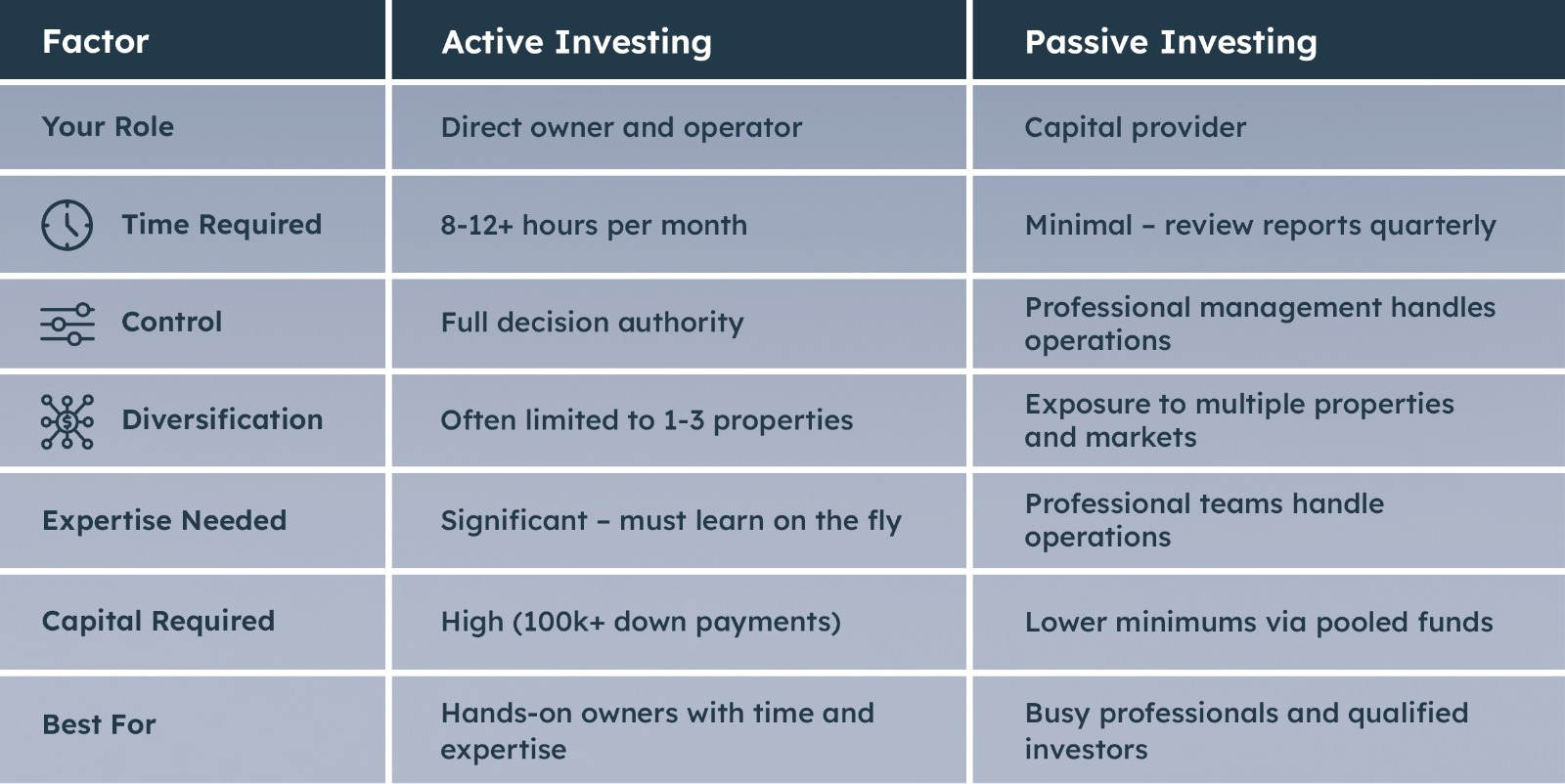
Active investing means buying and managing properties yourself. You control tenant selection, rent pricing, and operational decisions. While this can potentially deliver strong returns, the capital, time, and expertise required often make it impractical for most investors.
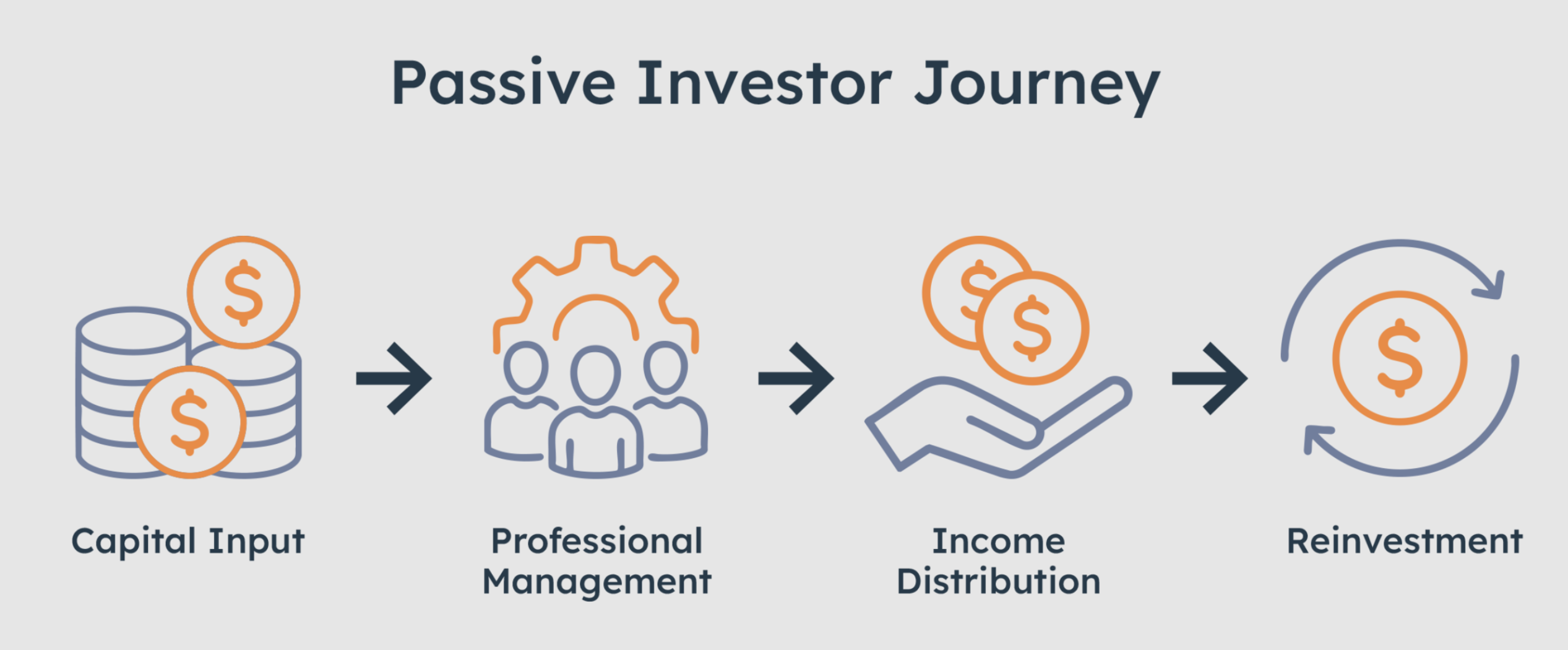
Passive investing allows you to allocate capital to professionally managed funds or syndications. Management teams handle acquisitions, operations, and reporting, so investors can seek to capture income and potential appreciation without daily operational responsibilities.
For accredited investors, passive strategies provide access to institutional-grade properties, diversified portfolios, and professional management expertise, making it easier to act on the belief that real estate can help build long-term wealth.
Understanding Active and Passive Real Estate Investing
At its core, real estate investing is a tradeoff between control and convenience. Understanding this distinction is the first step toward choosing the right strategy for building passive income.
Disclaimer:
The projections, estimates, and any modeling tools referenced in this article are provided for illustrative purposes only and are not intended to reflect actual or future performance. These examples are based on assumptions that may not materialize and do not account for all possible variables or real-world conditions.
Actual results may differ materially due to a variety of factors, including but not limited to economic and market fluctuations, changes in interest rates, and other unforeseen events. Modeling tools have inherent limitations and cannot fully predict future outcomes.
This information is intended for general educational purposes only and should not be relied upon as a guarantee of future results or as investment advice. Investors should conduct their own analysis and consult with accredited professionals before making any investment decisions.
Active investors aim to capture the full upside of ownership but must navigate financing, tenant management, and market risk, factors that keep many Americans from acting on their real estate ambitions.
Investing passively alongside an experienced firm, on the other hand, can potentially allow investors to bridge the gap, offering wealth-building exposure with fewer operational headaches or the high entry costs associated with direct ownership.
Pros and Cons of Active Real Estate Investing
Time Commitment and Effort
A common barrier keeping Americans from acting on their belief that real estate builds wealth is the sheer time and operational expertise required for active investing.
Landlords who self-manage report spending an average of 8–12 hours per month per property just on management tasks, meaning a small five-unit portfolio can demand 60+ hours of oversight each month.4
This work includes tenant communication, rent collection, maintenance coordination, inspections, legal compliance, and general administration. In Fact:
65%
of self-managing landlords report feeling overwhelmed by these demands.
43%
say property management has negatively impacted their primary income or career focus.
Even beyond the hours, the complexity of decisions, from financing and due diligence to handling vacancies and legal compliance, requires skills most average investors need to learn on the fly. Broad surveys indicate that 90% of residential real estate investors face significant challenges, and 40% say they wish they had never started due to day-to-day hassles and financial risks.4
For many Investors, these barriers, time, effort, and expertise explain why intent does not translate into action, despite real estate being perceived as a top wealth-building investment option.1
Risk and Potential Returns
Active investors assume full property-level risk, meaning vacancies, repairs, market fluctuations, and local economic changes directly impact their returns. While the potential returns are high, mistakes can be costly, requiring expertise in market timing, property management, and operations.
Access to Property Types and Financing Challenges
Individual investors are often limited to smaller properties (single-family homes, duplexes, small multifamily buildings). Larger institutional-style assets, like mid-rise apartments or commercial buildings, require:
- Significant capital
- Specialized financing
- Advanced operational experience
Financing complexity, mortgage approval, large down payments, interest rate risk, and refinancing hurdles, adds additional barriers, preventing many Americans from acting on their desire to invest in real estate.
Pros and Cons of Passive Real Estate Investing
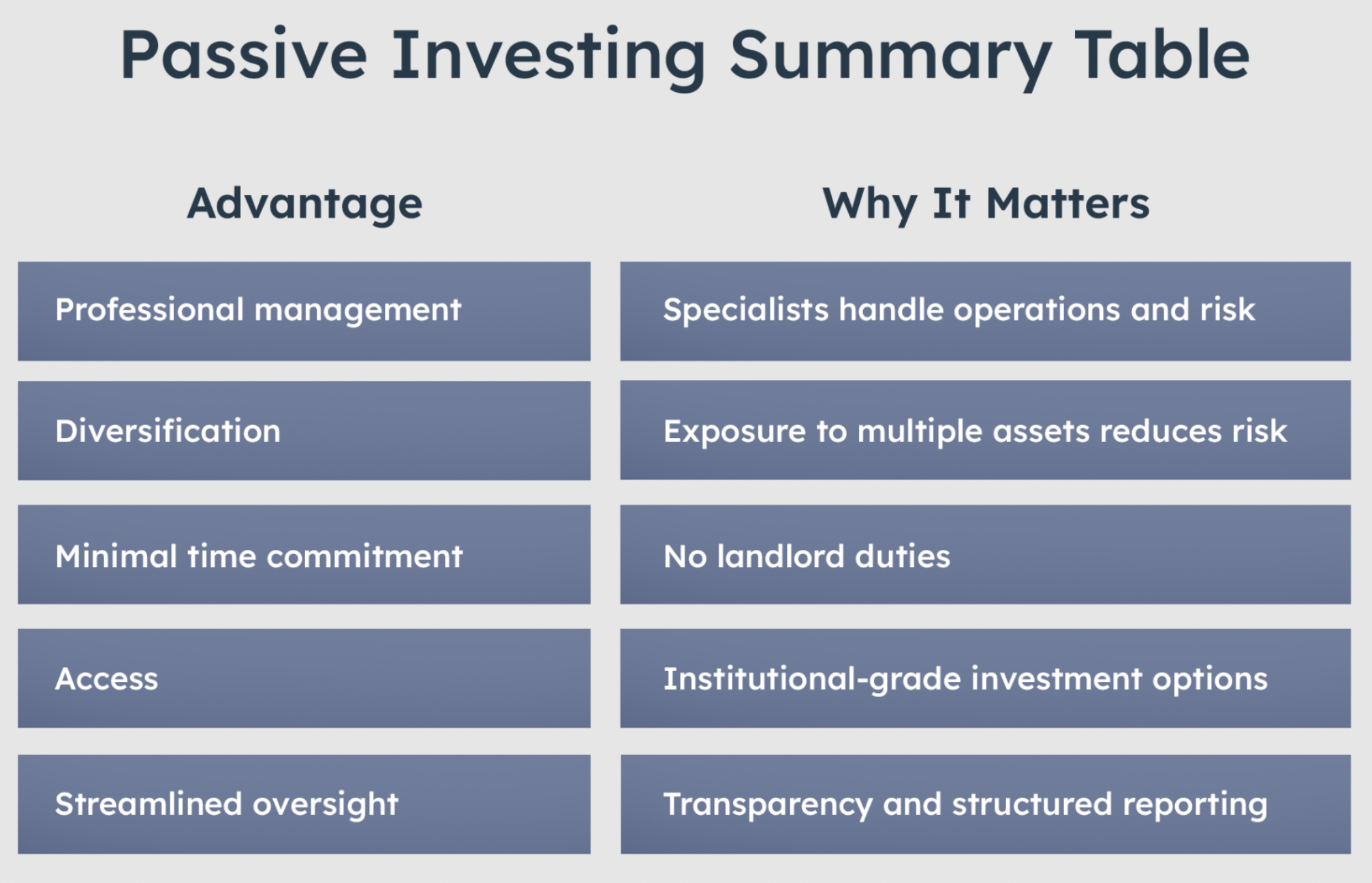
Passive investing can help make real estate accessible to investors who want wealth-building exposure without managing properties themselves. Capital is allocated to professionally managed vehicles, such as professionally managed funds or syndications.
Lower Risk and Professional Management
Professional teams handle:
- Market research and property selection
- Financial underwriting and modeling
- Financing and refinancing strategies
- Tenant and property management
- Reporting and compliance
By outsourcing day-to-day management to professional teams, passive investors shift operational responsibilities while still participating in income and potential appreciation, helping mitigate operational risk.
Multifamily housing is designed with the potential to provide stable and scalable passive income through cash flow from multiple tenants, long-term appreciation potential, and professional management without direct ownership challenges.
Through private real estate funds, investors can pool capital to access large, professionally managed apartment properties that would typically be out of reach for individual buyers.
Portfolio Diversification and Access to Multiple Properties
Pooling capital allows access to:
- Institutional-grade assets
- Multiple property types and geographic regions
- Diverse tenant profiles
- Staggered financing and maturity schedules
Diversification can help smooth returns, reduce volatility, and lessen the impact of any single property’s performance. This is an important consideration for accredited investors seeking both growth and stability.
Minimal Effort and Day-to-Day Involvement
Passive investors typically:
- Review performance updates and reports
- Monitor market updates
- Make strategic allocation decisions
Rental Properties vs. Private REIT: Comparing Your Options
Traditional Rental Property Investing
Advantages:
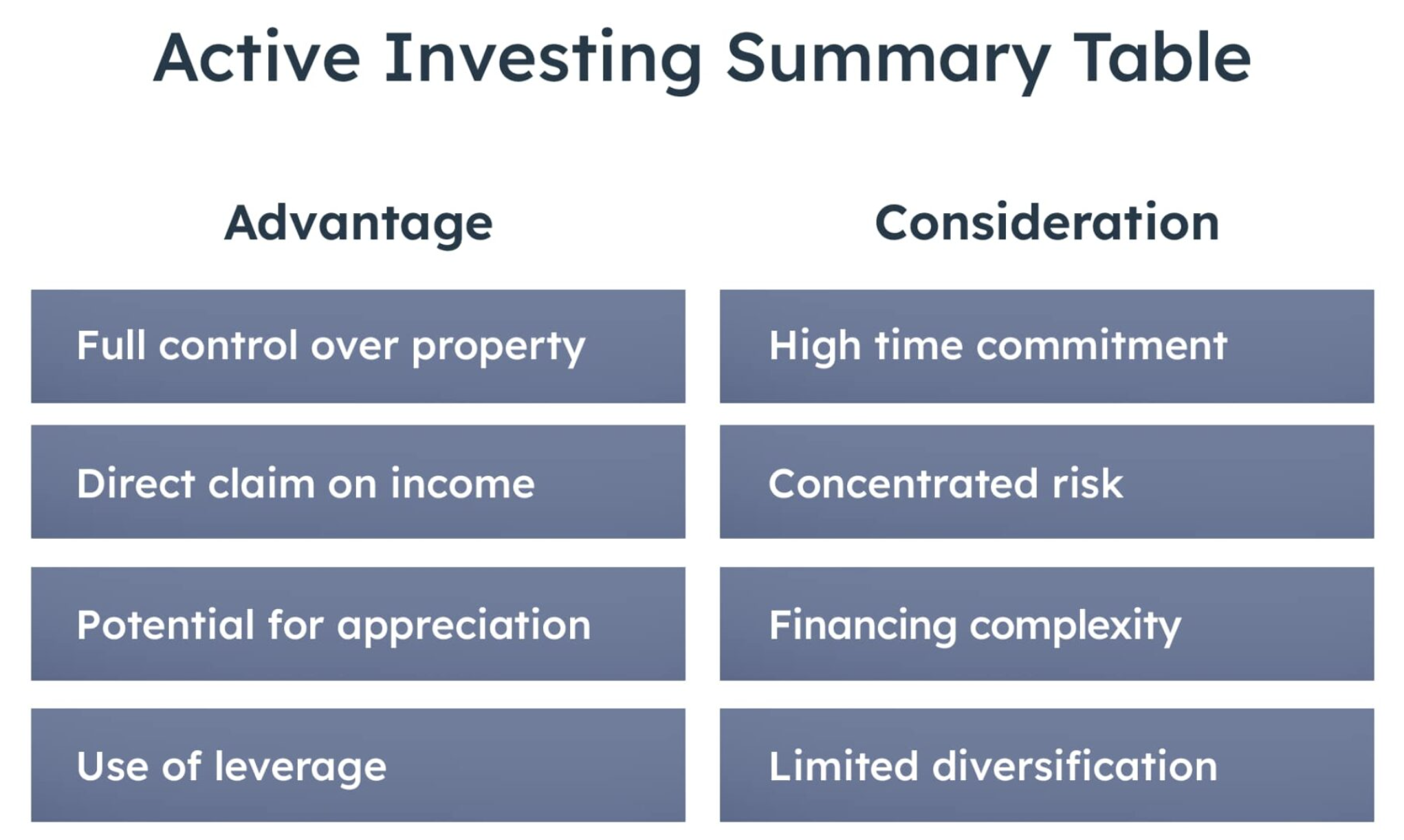
- Full control over decisions, tenants, and pricing
- Direct claim on income and property appreciation
- Ability to leverage financing
Challenges:
- Concentrated exposure to single properties
- High management responsibilities
- Limited liquidity
- Financing complexity
Active investing suits investors with time, expertise, and capital, a small subset of the population.
Private REIT Income Advantages
Private funds provide:
- Access to professionally sourced and managed portfolios
- Diversified property exposure
- Institutional-grade asset management
- Regular reporting and transparency
These funds help bridge the gap for investors who want real estate wealth-building exposure but cannot or do not want to manage properties themselves
Expertise in Identifying and Analyzing Opportunities
Successful investing requires expertise in:
- Market cycles and trends
- Property performance metrics
- Risk management strategies
- Financial modeling
- Legal and tax implications
Private funds provide access to experienced investment teams, lowering the barrier to entry and helping more Americans act on their real estate investment intentions.
Guidance on Private Real Estate Investment Strategies
Accredited investors evaluating private equity real estate funds should review:
Firm Track Record and Experience
When considering a private real estate fund, understanding the operator’s background is critical. Experienced managers with a history of acquiring, managing, and exiting properties demonstrate their ability to navigate different market conditions. Review prior projects, historical returns, and how the team performed during both high-growth periods and market downturns. An established track record tends to improve confidence in their ability to execute the fund’s strategy effectively.
Investment Philosophy and Value Creation Strategy
Every fund has a unique approach to generating returns. Some may focus on value-add properties, buying underperforming assets and improving them, while others target stabilized, income-generating properties or development projects. Investors should assess whether the sponsor’s philosophy aligns with their own risk tolerance and investment goals. Understanding how the sponsor plans to create value helps investors gauge the potential upside and sustainability of returns.
Risk Management Processes
Private real estate investments carry operational, market, and financial risks. Evaluate how the sponsor identifies, measures, and mitigates these risks. Do they have rigorous due diligence procedures for acquisitions? Are there policies for diversification across geography or property type? Strong risk management processes signal that the sponsor prioritizes preserving capital while pursuing growth opportunities.
Portfolio Construction Approach
A thoughtful approach to portfolio construction can potentially reduce volatility and optimize performance. Consider the fund’s diversification strategy how many properties, asset classes, and locations are included. Assess leverage levels, expected hold periods, and exit strategies. A balanced and well-structured portfolio can help smooth returns over time and protect investors from concentrated risks.
Reporting and Transparency Standards
Transparency is key to maintaining trust and monitoring performance. Investors should review the sponsor’s reporting practices: frequency of updates, types of metrics shared (occupancy, rent growth, expenses, valuations), and access to fund performance data. Clear, consistent reporting allows investors to make informed decisions and ensures accountability throughout the investment lifecycle.
By carefully vetting these areas, accredited investors can reduce operational and market risk while enhancing the potential for strong, sustainable returns. A disciplined evaluation of sponsors, strategies, risk management, portfolio construction, and transparency ensures that passive real estate investing moves beyond intention; it becomes a concrete, actionable path toward wealth creation.
FAQ / Related Questions
Yes – certain retirement accounts, like self-directed IRAs or solo 401(k)s, allow investment in private real estate funds, syndications, or direct property ownership. These accounts offer tax advantages, such as tax-deferred growth in traditional accounts or tax-free growth in a Roth IRA. There are restrictions: you can’t personally use the property or engage in transactions with disqualified parties. For a simpler approach, private equity real estate funds let accredited investors access professionally managed, diversified real estate without the operational burden.
Passive investing removes major obstacles like high capital requirements, operational responsibilities, and single-property concentration risk. By pooling funds with other qualified investors, you can access institutional-grade real estate at a fraction of the cost. Professional management handles tenants, repairs, and compliance, reducing stress and time commitment. Diversified portfolios also help stabilize income and mitigate market risk.
Accredited investors meet financial criteria set by regulators, usually: an individual income of at least $200,000 per year (or $300,000 jointly with a spouse) and a net worth over $1 million, excluding a primary residence. These standards ensure investors have the resources and experience to participate in private investment opportunities. Equiton guides potential investors in understanding these requirements and accessing suitable opportunities.
Diversification spreads capital across property types, locations, and investment structures to reduce exposure to any single asset or market. Private equity real estate funds provide this diversification in one allocation, professionally managed for income, growth, and risk mitigation. This approach lets qualified investors gain broad real estate exposure without handling day-to-day operations.
Stay Connected
Sign up to receive more real estate insights straight to your inbox and explore strategies, market trends, and educational resources designed for accredited investors seeking passive income through real estate.
Sources
- Gallup, “Stocks Fall, Gold Rises, Real Estate Tops Long-Term Investment Choices”, May 2025. gallup.com
- Bain & Company, Global Private Equity Report 2023. bain.com
- BiggerPockets, Hidden Costs of Self-Managing Your Portfolio, 2024. biggerpockets.com
- ListwithClever, Residential Real Estate Investing Survey, 2024. listwithclever.com
Disclaimers: Not an Offer, Recommendation or Professional Advice: This writing does not constitute advice or a recommendation or offer to sell or a solicitation to deal in any security or financial product. It is provided for information purposes only and on the understanding that the reader has sufficient knowledge and experience to be able to understand and make their own evaluation of the proposals and services described herein, any risks associated therewith and any related legal, tax, accounting or other material considerations. To the extent that the reader has any questions regarding the applicability of any specific issue discussed above to their specific portfolio or situation, prospective investors are encouraged to contact Equiton Capital LLC or consult with the professional advisor of their choosing.
Past Performance: There is no guarantee that the investment objectives will be achieved. Moreover, the past performance is not a guarantee or indicator of future results. Forward-Looking Statements: Certain information contained herein constitutes “forward-looking statements,” which can be identified by the use of forward-looking terminology such as “may,” “will,” “should,” “expect,” “anticipate,” “project,” “estimate,” “intend,” “continue,” or “believe,” or the negatives thereof or other variations thereon or comparable terminology. Due to various risks and uncertainties, actual events, results or actual performance may differ materially from those reflected or contemplated in such forward-looking statements. Nothing contained herein may be relied upon as a guarantee, promise, assurance or a representation as to the future.
The information provided in this article is for general educational purposes only and does not constitute investment, legal, or tax advice, nor should it be relied upon as a recommendation or an offer to buy or sell any security. Investing in real estate and real estate investment trusts (REITs) involves risks, including but not limited to fluctuations in property values, changes in interest rates, tenant vacancies, refinancing risk, and broader economic or market conditions. REITs may also be subject to liquidity constraints, leverage-related risks, and sector or geographic concentration risks, all of which can impact income and the value of an investment.
Diversification is often used as a risk management strategy; however, it does not ensure a profit and does not protect against loss in declining markets. All investments carry risk, and past performance is not indicative of future results. Investors should carefully consider their financial objectives, risk tolerance, and investment time horizon and should consult with qualified financial and tax professionals before making any investment decisions.